About this text. The text below is the order as printed in the Bar Counsel Report, taken from the State Bar's PDF and set in reading order (the magazine runs it across pages 37 to 40 in columns). The report's four footnotes on the order follow it; they are numbered 5 to 8 there and 1 to 4 in the order as filed, and the other pages of this site cite them by the order's numbers. Line breaks follow the magazine's columns.
In Re: MICHANCY M. CRAMER
Bar No.: 11545
Case No.: 86960
FILED: 12/12/2024
ORDER OF PUBLIC REPRIMAND
This is an automatic review of a Southern Nevada Disciplinary
Board hearing panel's recommendation that attorney Michancy
M. Cramer be publicly reprimanded. The State Bar alleged,
and the hearing panel found, that Cramer committed two
violations of RPC 3.4(c) (fairness to opposing party and
counsel), two violations of RPC 4.4 (a) (respect for rights of
third persons), and one violation each of RPC 3.5(d) (decorum
of the tribunal), and RPC 8.4(a), (d) (misconduct) during
two court hearings and after a deposition in 2020.5 The State
Bar challenges the hearing panel's finding that Cramer had
a negligent mental state when committing the various acts of
misconduct. Cramer disagrees and also challenges the hearing
panel's findings as to several of the violations.
The State Bar has the burden of showing by clear and
convincing evidence that Cramer committed the violations
charged. In re Discipline of Drakulich, 111 Nev. 1556, 1566,
908 P.2d 709, 715 (1995). "Our review of the panel's findings
of fact is deferential, so long as they are not clearly erroneous
and are supported by substantial evidence." In re Discipline
of Colin, 135 Nev. 325, 330, 448 P.3d 556, 560 (2019) (citing
SCR 105(3)(b)). However, we apply de novo review to the
panel's conclusions of law. SCR 105(3)(b).
Having reviewed the record and considered the parties'
arguments, we agree with the hearing panel that Cramer
violated RPC 3.4(c), RPC 4.4(a), and RPC 8.4(a), (d). As to
the RPC 3.4 violations, we agree with the hearing panel that
Cramer "[k]nowingly disobey[ed] an obligation under the rules
of a tribunal," RPC 3.4(c), by ignoring the court's multiple
admonitions to discontinue certain lines of questioning. We also
agree that Cramer violated RPC 4.4(a) by using a derogatory
term when referring to a party during a May 13, 2020, hearing
and by calling opposing counsel a vulgar name during an
argument after a deposition on August 3, 2020. In both
instances, substantial evidence supports that Cramer had "no
substantial purpose other than to embarrass" those third parties
by her comments. RPC 4.4(a) ("[A] lawyer shall not use means
that have no substantial purpose other than to embarrass, delay,
or burden a third person … ."). Finally, because Cramer's
actions violated the Rules of Professional Conduct and her
conduct during hearings on May 13, 2020, and September 11,
2020, disrupted the tribunal, we also conclude that Cramer
violated RPC 8.4(a) and (d).6 See RPC 8.4(a) (providing
that it is misconduct for an attorney to violate the Rules of
Professional Conduct), (d) ("It is professional misconduct for
a lawyer to … [e]ngage in conduct that is prejudicial to the
administration of justice."); In re Discipline of Colin, 135 Nev.
 325, 332, 448 P.3d 556, 562 (2019) (explaining that conduct that
"is intended to or does disrupt a tribunal" may constitute an RPC
8.4(d) violation).
As to the RPC 3.5(d) violation, however, we conclude that
substantial evidence does not support the panel's findings. The
plain language of RPC 3.5(d) provides that "[a] lawyer shall
not engage in conduct intended to disrupt a tribunal." Here, the
panel found that Cramer violated RPC 3.5(d) by her conduct
during a May 13, 2020, court hearing in which she made
inappropriate comments to a witness and opposing counsel.
And while we conclude that Cramer acted with a knowing
mental state during the May 13, 2020, hearing, the record does
not support that she acted with an intent to disrupt the court
proceedings. Accordingly, we conclude that the panel erred in
finding that Cramer violated RPC 3.5(d).
In determining the appropriate discipline for Cramer's
violations of RPC 3.4(c), RPC 4.4(a), and RPC 8.4(a), (d), we
weigh four factors: "the duty violated, the lawyer's mental state,
the potential or actual injury caused by the lawyer's misconduct,
and the existence of aggravating or mitigating factors." In re
Discipline of Lerner, 124 Nev. 1232, 1246, 197 P.3d 1067,
1077 (2008). Cramer violated duties owed to the legal
profession (fairness to opposing party and counsel, impartiality
and decorum of the tribunal, respect for rights of third persons,
and misconduct). We agree with the panel that Cramer's
actions caused actual or potential injury by potentially
delaying the proceedings and resolution of the matters at issue
in the respective litigations. However, we disagree with the
panel's conclusion that Cramer's mental state in committing
these acts of misconduct was negligent. 7 Rather, the record
demonstrates that Cramer had a knowing mental state during
the May 13, 2020, and September 11, 2020, hearings. In
particular, she appeared to have a "conscious awareness of
the nature or attendant circumstances of" her actions but did
not appear to have the intent to accomplish a particular result
beyond representing her client at those hearings. Standards
for Imposing Lawyer Sanctions, Compendium of Professional
Responsibility Rules and Standards, 452 (Am. Bar Ass'n
2023) (Standards) (defining a knowing mental state). We
further conclude that the record demonstrates that Cramer's
conduct after the August 3, 2020, deposition, during which she
called opposing counsel a vulgar name after asking opposing
counsel to leave Cramer's office, was done with an intentional
mental state. Indeed, the record demonstrates that Cramer had
a "conscious objective or purpose to accomplish a particular
result," id. (defining an intentional mental state), particularly
since she directed her comments to opposing counsel after she
had left the office and then repeated the vulgar terminology a
second time when questioned.
Because the most serious misconduct was Cramer's
intentional violation of her duty to respect the rights of third
parties, the baseline sanction, before considering aggravating or
mitigating circumstances, is suspension. See Standards, Standard
6.22 ("Suspension is generally appropriate when a lawyer knows
that he or she is violating a court order or rule, and causes injury
or potential injury to a client or a party, or causes interference
or potential interference with a legal proceeding."). Substantial
evidence in the record supports two aggravating circumstances
(multiple offenses and substantial experience in the practice
of law) and five mitigating circumstances (absence of a prior
disciplinary record, absence of a dishonest or selfish motive,
personal or emotional problems, interim rehabilitation, and
remorse). See SCR 102.5 (listing "[a]ggravating and mitigating
circumstances [which] may be considered in deciding what
sanction to impose"). Weighing the mitigating and aggravating
circumstances, and the minimal actual injury, we agree with the
panel's recommendation that a downward deviation from the
baseline sanction of suspension is appropriate. Thus, considering
all of the Lerner factors, we conclude that a public reprimand
is sufficient to serve the purpose of attorney discipline. See State
Bar of Nev. v. Claiborne, 104 Nev. 115, 213, 756 P.2d 464, 527-
28 (1988) (recognizing that the purpose of attorney discipline is
to protect the public, the courts, and the legal system).
Accordingly, we hereby publicly reprimand attorney
Michancy M. Cramer for violating RPC 3.4(c) (fairness to
opposing party and counsel), RPC 4.4(a) (respect for rights of
third persons), and RPC 8.4(a), (d) (misconduct). Cramer shall
pay the costs of the disciplinary proceedings, plus fees in the
amount of $1,500, see SCR 120(3), within 30 days from the
date of this order.8 Cramer shall also be required to complete
an additional six (6) hours of continuing legal education in the
area of civility, in addition to her annual CLE requirement. The
State Bar shall comply with SCR 121.1.
It is so ORDERED.

Notes
(The report numbers the order's footnotes 5 to 8; in the order as filed they are 1 to 4.)
5. The State Bar also brought additional allegations against
Cramer, which the hearing panel found unproven. The State Bar
does not challenge those findings.
6. We reject Cramer's argument that the RPC 8.4 charges should
be dismissed as duplicative. We agree with Cramer, however,
that her line of questioning about a car insurance policy during a
hearing on September 11, 2020, was for a proper purpose.
7. We reject Cramer's argument that a negligent mental state
is supported by her testimony that she was suffering from
a stress-related medical condition when she committed the
misconduct. Although Cramer's medical condition may be
considered as a mitigating circumstance (e.g., personal or
emotional problems and physical or mental disabilities) "after
misconduct has been established," Standards for Imposing
Lawyer Sanctions, Compendium of Professional Responsibility
Rules and Standards , Standards 9.1, 9.3 (Am. Bar Ass'n 2023);
see also SCR 102.5(2) (listing mitigating circumstances), we
are not convinced that it establishes negligence with respect to
the misconduct.
8. Cramer shall pay the State Bar's costs jointly and severally with
attorney Alex B. Ghibaudo, but Cramer is solely responsible for
the $1,500 fee pursuant to SCR 120(3).
The rules the court applied
| Rule | As the order describes it | Finding |
|---|---|---|
| RPC 3.4(c) | fairness to opposing party and counsel: a lawyer shall not knowingly disobey an obligation under the rules of a tribunal | Violated (two counts): "ignoring the court's multiple admonitions to discontinue certain lines of questioning" |
| RPC 4.4(a) | respect for rights of third persons: a lawyer shall not use means that have no substantial purpose other than to embarrass, delay, or burden a third person | Violated (two counts): a derogatory term for a party at the May 13, 2020 hearing; a vulgar name for opposing counsel after the August 3, 2020 deposition |
| RPC 8.4(a), (d) | misconduct: violating the Rules of Professional Conduct; conduct prejudicial to the administration of justice | Violated: her conduct at the May 13 and September 11, 2020 hearings "disrupted the tribunal" |
| RPC 3.5(d) | decorum of the tribunal: conduct intended to disrupt a tribunal | Not violated: the panel's finding was reversed; the court found a knowing mental state but no intent to disrupt |
Documents cited on this page
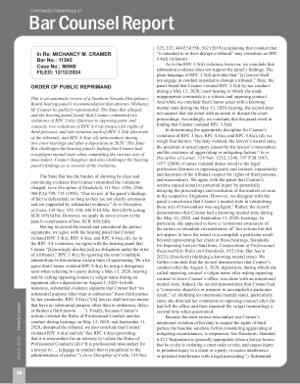
The served copy is the State Bar's own PDF of its Bar Counsel Report with the pages that carry her order and its notes extracted; nothing is altered. A quotation's link opens the copy at the page that carries the quoted words. The full report, which also covers other attorneys, is at nvbar.org; the order itself is on Nevada Supreme Court docket No. 86960. See Sources.
Comments
Comments post as written, at once. No account, no address; a name is optional. The only comments held for a human read are those that name a protected private person, give contact details, contain a threat, or are spam (see About).
Loading comments.